WELCOME TO AQUA FLEX'N STRETCH!!!

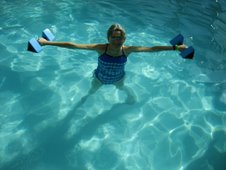
Experience 'All in One' combo classes of strength, cardio, and flexibility training with Aqua Flex'n Stretch as well as specialized classes for Arthritis, Fibromyalgia, Parkinson's, and other muscle conditions. Our certified instructors are top in the Los Angeles area and focus on overall health and wellness in small classes for maximum personal attention in salt and chlorine pools! The secret to success is having fun, making social connections, feeling good, and being energized. Take the plunge!


DON'T WAIT ---- CALL 818-383-4400 OR EMAIL AT AQUAFLEXN@SBCGLOBAL.NET FOR MORE INFO


2013 CLASS SCHEDULE

**PROVIDENCE/TARZANA OUTPATIENT THERAPY CENTER SALT-WATER POOL (5359 Balboa Blvd., next to 101 Freeway, Encino)
RSVP TO RESERVE YOUR SPOT!!!!
818-383-4400
All classes limited to 6 participants per class! Lots of 1:1 instruction!! FIRST COME, FIRST SERVE!
Open to the community.

Private and semi-private sessions.

Chair lift is available. Towels, all equipment, locker room and shower provided.
AQUATONE (1-hour):
(Work your whole body-cardio; strength and flexibility/balance; Adjusted for Arthritis Foundation as needed)
MONDAY: 4:30pm

MONDAY/WEDNESDAY: 5:30pm

TUESDAY/THURSDAY: 11:30am

THURSDAY: 7pm
SATURDAY: 11:15am

Fees: $150/8 classes; 1-month expiration
$20/drop-in with reservation
NEW YOQUATIX on Sundays!!!

45 minutes of restorative land yoga PLUS
45 minutes of restorative aqua

9:30 am and 10:30 classes

Half-price 1st class--only $20!!

Fees: $40/90 minutes; $150/4 classes

**BRAEMAR COUNTRY CLUB (Tarzana):
Beautiful outdoor heated pool in
Santa Monica hills.
HIIT The Water! Hi-Intensity!

SATURDAY: 9:30am - 10:30am

Aqua Tone

TUESDAY/THURSDAY: 11am - 12pm

Members:
Group: 1 class: $20; 8 class package: $150
Private: 1 class: $90; 4 class package: $350
Semi-Private: 1 class: $45; 4 class package: $170

Non-Members:
Group: 1 class: $22; 8 class package: $155
Private: 1 class: $95; 4 class package: $375
Semi-Private: 1 class: $50; 4 class package: $195
$29 one-time non-member fee

Free parking, towels, lockers, equipment

CALL 818-383-4400 OR EMAIL aquaflexn@sbcglobal.net

**FOUR SEASONS CENTER FOR HEALTH AND LONGEVITY (Westlake Village)
Private and semi-private sessions are available at this first-class heated indoor pool for members and hotel guests.
**AT-HOME PRIVATE/GROUP SESSIONS:
Want the convenience of a private class at your home? Or, put together your own group, and we'll come to you!
CALL 818-383-4400 or EMAIL at aquaflexn@sbcglobal.net
http://www.linkedin.com/

Showing posts with label physical. Show all posts

Monday, January 14, 2013

Physical Activity and Quality of Life with Arthritis


Physical Activity Adherence and Quality of Life among Individuals with Arthritis
By Kelsey Stamps
Austin, S., Qu, H., & Shewchuk, R. M. (2011). Association between adherence to physical activity guidelines and health-related quality of life among individuals why physician-diagnosed arthritis. Quality of Life Research, 21, 1347-1357.
Purpose:
Physical activity is an important, non-pharmacological intervention to diminish pain and discomfort and to improve health-related quality of life in individuals with one of the most prevalent chronic conditions, arthritis. Health-related quality of life (HRQOL) is an indicator of physical and mental health, and a population’s chronic disease load. It evaluates the impact of arthritis, which is a leading cause of disability both in the U.S. and internationally. Adults with arthritis have poor HRQOL and, on average, report four more physically unhealthy days and 2.3 more mentally unhealthy days (within a 30 day period), compared to those without arthritis. After assuming that HRQOL for adults with arthritis would be predicted by adherence to physical activity guidelines controlling for health system factor (physicians’ recommendations for physical activity), pre-disposing, enabling, and need-relation factors, the authors hypothesized that individuals who did not adhere to recommended levels of physical activity would report more physically and mentally unhealthy days compared with those who did, controlling for physicians’ recommendations, predisposing, enabling, and need-related factors.
Conclusion: 
Individuals who did not adhere to the physical activity guidelines had more physically and mentally unhealthy days. By engaging in low- to moderate-intensity physical activity of approximately 150 minutes per week, evidence shows that individuals with arthritis had some degree of relief from pain, improved their physical function, and delayed onset of disability. The 150 minutes per week consisted of five 30-minute sessions. However, this study proved that adherence to physical activity is low in this population and interventions are needed to connect adults with arthritis to participate in physical activity. It is recommended that even if adults with other co-morbidities cannot meet at least 150 minutes per week they should still be physically active as much as possible whenever their conditions and abilities allow. 

Wednesday, September 12, 2012

ARTFUL AGING

Artful Aging by Dr. Suzanne Groah


As a physician and scientist, I have seen remarkable aging. The patients whom I care for, often with severe physical disabilities, experience a process termed “accelerated aging.” This means that some of the “normal” declines in body organ function that we see associated with age occur earlier than anticipated. Unfortunately, the result is a shorter lifespan for these individuals.
I have seen a number of people, though, who have outlived expectations — some by years and a few by decades. I want to learn from these people so that I can discover the Art of Aging, live it myself, and share it with others.
The example that is most striking is a patient and friend who was involved in a car accident 50 years ago at age 20. The accident left him paralyzed at the waist due to a broken back. If this happened today, we would anticipate he would live a productive life using a wheelchair and have about 45 years to live. Fifty years ago this number would have been much lower. For the first few years after his injury he worked hard to achieve his goal of walking. He accomplished this without regaining even a muscle twitch in his legs. He has walked using leg braces, crutches, and Hulk-like upper body strength. More incredible is that he has done it for the past 50 years — a feat well beyond anything I have ever observed.
To me, Ed exemplifies the Art of Aging. I am convinced that his commitment to physical activity — to stand when most would have sat and to continue to be physically active even when faced with life’s greatest challenges — is the key to his artful aging. As stated by Chinese microbiologist, Zhao Liping, “EAT RIGHT, KEEP FIT, LIVE LONG, DIE QUICK”.

Dr. Suzanne Groah is a physician and researcher in Washington, DC. www.SCI-Health.org

Tuesday, August 14, 2012

Fitness and Happiness!

It's true!!!


Fitness professionals and enthusiasts are well aware of the positive effects that exercise can have on mood. A report from the Journal of Sport & Exercise Psychology (2011; 33 [6], 884–902) takes this common knowledge one step further, suggesting that exercise is associated with feelings of excitement and enthusiasm.
According to the authors, “Physical activity was not associated with pleasant-deactivated, unpleasant–activated or unpleasant–deactivated feelings. People who were more physically active overall had higher pleasant–activated feelings than people who were less physically active. People reported higher levels of pleasant-activated feelings on days when they were more physically active than was typical for them.”

Thursday, August 25, 2011

Aquatic Exercise and Fibromyalgia (FMS)

Aquatic Therapy and Exercise has been recommended for the relief of Fibromyalgia pain. This article clearly discusses the benefits of the working in the water.

http://physical-therapy.advanceweb.com/Archives/Article-Archives/A-Good-Match.aspx

Monday, November 29, 2010

Exercise and Type 2 Diabetes--Important info

Updated position statement on exercise and type 2 diabetes.

A joint position statement from the American College of Sports Medicine and the American Diabetes Association states that high-quality studies confirm that physical activity “plays a major role” in the prevention and management of type 2 diabetes, and that exercise needs to be performed regularly to have a continued benefit.

(SOURCE: Medicine & Science in Sports & Exercise, 42(12):2282-2303 (December 2010))

Thursday, April 15, 2010

PSYCHING YOURSELF UP TO EXERCISE


Denny Bender, Let's Move Together Blogger
Download MP3


Want to exercise, but just can’t seem to get moving? When it comes to health and fitness, your state of mind, or emotional conditioning, is as important as your physical conditioning.  Here's some tips from the Arthritis Foundation to help get you mentally prepared for physical fitness.

  Results of a recent study show that fear of pain (not pain itself) ranked as the No. 1 barrier preventing people with arthritis from exercising. Other mental hurdles, like a lack of motivation and not enjoying exercise, also ranked high.


Few people focus on the mental aspects of physical fitness, whether it’s overcoming injury-related anxiety or simply getting motivated to lace up your sneakers each day. Changing your mind-set can help you live a more active life. So, before you exercise, get your mind ready.

So how do you get your mind and your body prepared for exercise? Follow these three emotional conditioning tips:

1.Be flexible. People who adjusted their exercise routine to accommodate their arthritis are more likely to keep exercising than those who don’t. Avoid an all-or-nothing mentality. If your knees hurt, resolve to walk more slowly. If you’re stiff in the morning, then exercise in the evenings. Or cut the length of your workout in half, if you’re really sore. Having a Plan B keeps you from giving up when things seem tough.

2.Focus on the benefits. People who exercise regularly do so because they believe it makes them feel better, promotes weight loss and increases their ability to move. Reminding yourself of how good exercise is for your health can motivate you to make the effort, even when you’re feeling tired, sore or nervous.

3.Soothe yourself. Being anxious or afraid can amplify pain, which is why it’s important to get calm before you get moving. Before you start exercising, spend several minutes breathing deeply while picturing yourself doing your chosen activity. Also practice positive self-talk before and during exercise, saying or thinking phrases like “I can do this,” and “I feel pain, but doing this will help me feel less pain.”

Friday, February 26, 2010

LEG AND FOOT CRAMPS

Do you find your muscles in legs and/or feet cramping up? Cramping happens often, especially when first starting exercise. Basically, cramping is a fatigue of the muscle, either physically or physiologically - when you are asking your muscles to do something they are not used to, even when you stand too long, walk too far, walk/wear the same shoes for too long, do some exercise it is not used to....thus the toes cramp when you start exercising. 
To help the cramps, stay hydrated, ease into your workouts, and keep the body supplied with the minerals and elements it needs, such as natural supplements like bananas and other foods. Eventually the feet and legs get stronger and the cramps will be reduced. Don't forget to skip the coffee or tea before a workout. They can dehydrate the body. Also, try a cup of tonic water with quinine. Or, try mustard. Amazingly, they work!

Thursday, May 21, 2009

Laughter Works!

Documented research has proved that laughter has enormous benefits on one’s physical, mental and emotional health. It is more than just a physical response. It is a great workout that boosts the immune system, increases circulation and the threshold for pain. Scientific studies show that laughter has positive effects on the heart, blood vessels, stress hormones, mental health and family relationships. These health benefits of laughter all contribute to smoother overall functioning, which in turn speeds injury healing and helps manage chronic pain. "He who laughs, lasts!"

Friday, March 6, 2009

Exercise Lowers Risk of Colon Cancer

Just reported by Washington University School of Medicine and Harvard University that people who exercised (any physical activity) the most were 24% less likely to develop colon cancer than those who exercised the least. This study indicates that physical activity is truly protective against colon cancer. The benefits of exercise are for both men and women. 

Thursday, February 26, 2009

10 Longevity Tips

According to Dr. Smith of the Jewish Home for the Aging in a recent article, living to 90 and beyond is pretty straightforward. He says, "the overall lesson is a simple one: Get out of bed in the morning and get active."

Apparently the Jewish Home has the highest number of residents living beyond 90. Based on their collective wisdom, here are Dr. Smith's top ten tips to increase your chances of reaching the century mark:

"1. Decide what is most important to you and focus on it. A lot of life's little annoyances don't seem so great if you keep your priorities straight.
2. Participate in some kind of physical exercise, depending on what your body will allow you to do.
3. Keep your mind sharp through mental exercise. The mind is a muscle. It must be used.
4. Have a balanced diet and pay attention to what you eat. In short, eat right.
5. Avoid isolation. Find someone to love and something to keep you engaged.
6. Relax. Don't let stress eat you up. The older people get, the more they seem to understand that it doesn't pay to sweat the small stuff.
7. Don't smoke at all and don't drink too much.
8. Remain spiritual. Believe in something.
9. Laugh every day. Happiness breeds contentment and laughter remains one of the best medicines.
10. Keep 'spice' in your life. Either in your food, your reading or your love life."

Makes a lot of sense! 

Tuesday, February 3, 2009

New Fibromyalgia Medicine Approved

The US Food and Drug Administration has approved Savella (mlnacipran) for the management of fibromyalgia. It has demonstrated significant improvements in multiple aspects of fibromyalgia, including pain, patient global assessment, and physical function. (National Fibromyalgia Association, January 30, 2009)

Thursday, April 10, 2008

Physical Activity Is Natural Pain Reliever For Arthritis

It may seem counterintuitive to exercise when suffering with joint pain, but physical activity is actually a natural pain reliever for most people suffering from arthritis according to a recent study published in Arthritis Care and Research journal. The study concluded that regular exercise is effective in significantly improving and managing arthritis pain.

Arthritis is projected to increase by 40 percent, affecting 67 million Americans, in the next two decades. Participants in the study reported a decrease in pain and fatigue, an increase in upper and lower extremity function, and an increase in strength after participating in a basic, eight-week exercise program. Exercising for joint health is different than exercising for cardio health. People living with arthritis don't have to sweat to achieve success. "Even minor lifestyle changes like taking a 10-minute walk three times a day can reduce the impact of arthritis on a person's daily activities and help to prevent developing more painful arthritis," explains Patience White, M.D., chief public health officer of the Arthritis Foundation. "Physical activity can actually reduce pain naturally and decrease dependence on pain medications."

Friday, May 18, 2007

JUST PLANE STIFF

For all the travelers this season, sitting on a plane is tough on our joints. Here are some tips from the Physical Therapy Association to keep prevent stiffness and pain. Do each of them 5-10 times throughout the flight.

1. Heel raises: Sit with feet flat on floor, lift heels off floor, hold for 5-10 seconds and lower

2. Ankle circles: Lift one leg slightly off ground and circle foot clockwise counterclockwise each 15 times, repeat with other leg

3. Overhead stretches: Reach arms straight up and stretch for 10 seconds, lean to left and then right, bend at waist, open and close hands, circle wrists as your stretch

4. Back Twists: Reach right arm across body and grab the left armrest. Slowly turn body and head as far to left as comfortable and hold for 5-10 seconds.

5. Curl downs: Pull stomach and chin in while sitting and gently curl your body down very slowly, reaching hands toward the floor. Hold 5-10 seconds and slowly uncurl.

Happy travels!