WELCOME TO AQUA FLEX'N STRETCH!!!
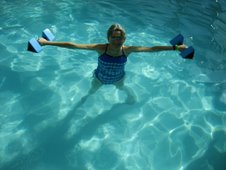
Experience 'All in One' combo classes of strength, cardio, and flexibility training with Aqua Flex'n Stretch as well as specialized classes for Arthritis, Fibromyalgia, Parkinson's, and other muscle conditions. Our certified instructors are top in the Los Angeles area and focus on overall health and wellness in small classes for maximum personal attention in salt and chlorine pools! The secret to success is having fun, making social connections, feeling good, and being energized. Take the plunge!
DON'T WAIT ---- CALL 818-383-4400 OR EMAIL AT AQUAFLEXN@SBCGLOBAL.NET FOR MORE INFO
2013 CLASS SCHEDULE
**PROVIDENCE/TARZANA OUTPATIENT THERAPY CENTER SALT-WATER POOL (5359 Balboa Blvd., next to 101 Freeway, Encino)
RSVP TO RESERVE YOUR SPOT!!!!818-383-4400
All classes limited to 6 participants per class! Lots of 1:1 instruction!! FIRST COME, FIRST SERVE!
Open to the community.Private and semi-private sessions.Chair lift is available. Towels, all equipment, locker room and shower provided.AQUATONE (1-hour):(Work your whole body-cardio; strength and flexibility/balance; Adjusted for Arthritis Foundation as needed)
MONDAY: 4:30pmMONDAY/WEDNESDAY: 5:30pmTUESDAY/THURSDAY: 11:30amTHURSDAY: 7pm
SATURDAY: 11:15amFees: $150/8 classes; 1-month expiration$20/drop-in with reservation
NEW YOQUATIX on Sundays!!!45 minutes of restorative land yoga PLUS45 minutes of restorative aqua9:30 am and 10:30 classesHalf-price 1st class--only $20!!Fees: $40/90 minutes; $150/4 classes**BRAEMAR COUNTRY CLUB (Tarzana):
Beautiful outdoor heated pool in
Santa Monica hills.
HIIT The Water! Hi-Intensity!SATURDAY: 9:30am - 10:30amAqua ToneTUESDAY/THURSDAY: 11am - 12pmMembers:Group: 1 class: $20; 8 class package: $150Private: 1 class: $90; 4 class package: $350Semi-Private: 1 class: $45; 4 class package: $170Non-Members:Group: 1 class: $22; 8 class package: $155Private: 1 class: $95; 4 class package: $375Semi-Private: 1 class: $50; 4 class package: $195$29 one-time non-member fee
Free parking, towels, lockers, equipmentCALL 818-383-4400 OR EMAIL aquaflexn@sbcglobal.net
**FOUR SEASONS CENTER FOR HEALTH AND LONGEVITY (Westlake Village)
Private and semi-private sessions are available at this first-class heated indoor pool for members and hotel guests.
**AT-HOME PRIVATE/GROUP SESSIONS:
Want the convenience of a private class at your home? Or, put together your own group, and we'll come to you!
CALL 818-383-4400 or EMAIL at aquaflexn@sbcglobal.net
http://www.linkedin.com/
Showing posts with label exercise. Show all posts
Wednesday, March 6, 2013
MYTH: EXERCISING IN A FASTING STATE TO PROMOTE FAT BURNING WILL RESULT IN BODY FAT LOSS
FACT: While research shows that exercising in a fasted state allows one to burn more fat, there is inconclusive and little scientific support for a link between fat burning and body fat loss. In fact, exercising in a fasted state may reduce exercise capacity overall and decrease the quality of the workout – and it is possible to experience lightheadedness or dizziness if blood sugar becomes too low during exercise.
“Fat burning” refers to the body’s ability to oxidize (or burn) fat by using fat instead of carbohydrate as a fuel source. Fat burning is often associated with body weight or body fat loss; however, in order for one to lose weight, he must consume fewer calories than he expends consistently over a period of time. This is why exercising in the “fat burning zone,” a lower intensity zone, is often not ideal for reductions in body weight if one is capable of exercising at a higher intensity.
Carbohydrates are important in an individual’s diet because they are the primary fuel for the muscles during exercise (and for the brain all the time!). As exercise intensity increases, the body relies more and more on carbohydrate as a fuel source – so, when you’re exercising at moderate to high intensities (and expending more calories in doing so), your body’s capacity to perform such work is dependent on carbohydrate fuel.” (IDEA Fitness, 3/6/13)
Wednesday, February 27, 2013
Bigger is better: Aquatic exercise benefits people with Parkinson's disease
According to the Parkinson’s Disease Foundation, aging is an important risk factor for Parkinson’s disease. The good news is that people with Parkinson’s disease who exercise regularly are able to move and maintain balance better than those who do not. And water is a wonderful environment for exercise. Water boasts unique properties that enable it to be used for both therapy and fitness. When someone with Parkinson’s is able to float and move in a pool, it is similar to a water lily opening at dawn. Participants can stand up tall and move more freely. (Intl. Council on Active Aging, 2/27/13)
Labels:
active,
aging,
aquatic,
balance,
disease,
exercise,
fitness,
parkinson's,
pool,
therapy,
water
Wednesday, September 12, 2012
ARTFUL AGING
Artful Aging by Dr. Suzanne Groah
|
As a physician and scientist, I have seen remarkable aging. The patients whom I care for, often with severe physical disabilities, experience a process termed “accelerated aging.” This means that some of the “normal” declines in body organ function that we see associated with age occur earlier than anticipated. Unfortunately, the result is a shorter lifespan for these individuals.
I have seen a number of people, though, who have outlived expectations — some by years and a few by decades. I want to learn from these people so that I can discover the Art of Aging, live it myself, and share it with others.
The example that is most striking is a patient and friend who was involved in a car accident 50 years ago at age 20. The accident left him paralyzed at the waist due to a broken back. If this happened today, we would anticipate he would live a productive life using a wheelchair and have about 45 years to live. Fifty years ago this number would have been much lower. For the first few years after his injury he worked hard to achieve his goal of walking. He accomplished this without regaining even a muscle twitch in his legs. He has walked using leg braces, crutches, and Hulk-like upper body strength. More incredible is that he has done it for the past 50 years — a feat well beyond anything I have ever observed.
To me, Ed exemplifies the Art of Aging. I am convinced that his commitment to physical activity — to stand when most would have sat and to continue to be physically active even when faced with life’s greatest challenges — is the key to his artful aging. As stated by Chinese microbiologist, Zhao Liping, “EAT RIGHT, KEEP FIT, LIVE LONG, DIE QUICK”.
Dr. Suzanne Groah is a physician and researcher in Washington, DC. www.SCI-Health.org
Tuesday, August 14, 2012
Fitness and Happiness!
It's true!!!
Fitness professionals and enthusiasts are well aware of the positive effects that exercise can have on mood. A report from the Journal of Sport & Exercise Psychology (2011; 33 [6], 884–902) takes this common knowledge one step further, suggesting that exercise is associated with feelings of excitement and enthusiasm.
According to the authors, “Physical activity was not associated with pleasant-deactivated, unpleasant–activated or unpleasant–deactivated feelings. People who were more physically active overall had higher pleasant–activated feelings than people who were less physically active. People reported higher levels of pleasant-activated feelings on days when they were more physically active than was typical for them.”
Wednesday, August 1, 2012
Parkinson's --EXERCISE NOW say Doctors!!
Start exercising NOW—as soon as possible. Physicians rarely refer their patients to health and fitness programs at diagnosis because medications are very effective early on alleviating most of the symptoms and patients experience little change in function. Yet, according to recent surveys, it is at the time of diagnosis that patients often begin to consider lifestyle changes and seek education about conventional and complementary/alternative treatment options. Thus referrals to exercise, wellness programs as well as physical/occupational therapy would be best initiated at diagnosis, when it may have the most impact on quality of life (Parkinson Resource Organization, 2012).
Monday, April 30, 2012
FIBROMYALGIA PAIN RELIEF
Try Gentle Water-Based Workouts
Whether or not you're a water lover, you'll want to at least try water exercises. Numerous studies report that this form of low-impact exercise -- especially when done in warmwater -- can help reduce pain, stiffness, fatigue, and depression in many people with fibromyalgia. And you don't have to endure the back-and-forth monotony of swimming laps if that's not for you. There are a variety of fun, get-wet workouts to choose from -- including music-based aqua aerobics, underwater walking or jogging, strength training, stretching, and water-based relaxation therapies like yoga, tai chi, and Watsu. Heck, some spas and fitness centers even offer pool-based Zumba, hip hop, and country-western line dancing. (Real Age, 4/30/12)
Labels:
aerobics,
depression,
exercise,
fatigue,
fibromyalgia,
fitness,
muscle,
pain,
swimming,
training,
walk,
water,
workout
Thursday, April 26, 2012
EXERCISE AND THE BRAIN
Why would exercise build brainpower in ways that thinking might not? The brain, like all muscles and organs, is a tissue, and its function declines with underuse and age. Beginning in our late 20s, most of us will lose about 1 percent annually of the volume of the hippocampus, a key portion of the brain related to memory and certain types of learning.
Exercise though seems to slow or reverse the brain’s physical decay, much as it does with muscles. Although scientists thought until recently that humans were born with a certain number of brain cells and would never generate more, they now know better. In the 1990s, using a technique that marks newborn cells, researchers determined during autopsies that adult human brains contained quite a few new neurons. Fresh cells were especially prevalent in the hippocampus, indicating that neurogenesis — or the creation of new brain cells — was primarily occurring there. Even more heartening, scientists found that exercise jump-starts neurogenesis. Mice and rats that ran for a few weeks generally had about twice as many new neurons in their hippocampi as sedentary animals. Their brains, like other muscles, were bulking up. (NYTimes)
Sunday, November 20, 2011
Aerobic Exercise in Fibromyalgia Patients Improves Memory Efficiency
Georgetown University Medical Center
Areas of the brain responsible for pain processing and cognitive performance changed in fibromyalgia patients who exercised following a medication holiday, say researchers from Georgetown University Medical Center. They say the changes indicate brain functioning is more streamlined after an exercise intervention because less of the brain's resources is devoted to processing bothersome fibromyalgia perceptions such as pain.
The study, presented at the Society of Neuroscience's annual meeting, Neuroscience 2011, used functional MRI scans to assess changes in the brain. Researchers observed a decrease in brain activity in areas responsible for memory and pain control after fibromyalgia patients took part in an exercise regimen.
"The decreased brain activity we see in the area of cognition suggests that the brain is working more efficiently," explains Brian Walitt, M.D. M.P.H., director of the Fibromyalgia Evaluation and Research Center at Georgetown University Medical Center and senior study author. "We also see less brain activity in areas responsible for pain processing which might be aiding that efficiency." Walitt cautions that more research needs to be conducted before suggesting a change in clinical care for fibromyalgia.
Fibromyalgia is a medical disorder characterized by widespread pain, fatigue, disordered sleep, and cognitive changes. It is regarded as an interoceptive disorder in that it has no apparent cause, Walitt says. "In conditions like this, the body perceives something by mistake." The pain is not psychosomatic, but is real and likely produced by the central nervous system, he says.
To that end, the research team used fMRI to "provide a definitive measure of cognitive functioning, so that we can more scientifically measure the effect of exercise," says Manish Khatiwada, M.S., who will be presenting the results. "This is a novel approach to the study of fibromyalgia." (Khatiwada is working in the laboratory of co-author John VanMeter, Ph.D., director of the Center for Functional and Molecular Imaging.)
For this study, the researchers enrolled eighteen women with fibromyalgia, and gave them a baseline fMRI to assess working memory and questionnaires about their well-being and pain while they were on medication. They then were told not to use their medications for a "washout" period, and had a second fMRI and memory testing. After six weeks, they had another assessment. The final scan was taken after the volunteers engaged in a six-week period of exercise, which involved three 30-minute sessions of aerobic exercise each week with a trainer.
Memory and pain typically worsen in patients after stopping their medication - which was the experience of patients in this study. After six weeks of exercise, however, patients reported an improvement in overall well-being. However, their performance in the memory task did not change significantly when compared to their baseline study measurements. Despite a change in memory test performance, brain activity in the memory task and pain processing areas of the brain decreased.
"What we see is a less interference by pain activity which could be contributing to the decrease in activity in the memory section. Basically, the brain is using less energy for the same task," Walitt says.
Conclusions: Our results indicate that as the patients discontinue their current medication treatment and transition into the exercise treatment their subjective rating of change in pain initially increases and then decreases. Neuronal activity in areas recruited for an Nback working memory task follow an inverse pattern with an initial drop following medication cessation that increases on subsequent visits. These results are suggestive of the effect exercise on not only self report of global change in pain sensation in FM but also improvement in the network of cortical areas recruited in working memory. Thus, exercise may have benefit in both reducing FM symptoms and improving cognitive capacity.
Support: American College of Rheumatology Investigator Award; MedStar Health Women’s Auxillary Intramural Grant.
The authors report no personal financial interests related to the study. This research is supported by an American College of Rheumatology Investigator Award and a MedStar Health Women’s Auxiliary Intramural Grant.
Georgetown University Medical Center
The authors report no personal financial interests related to the study. This research is supported by an American College of Rheumatology Investigator Award and a MedStar Health Women’s Auxiliary Intramural Grant.
Georgetown University Medical Center
Labels:
aerobics,
brain,
cognitive,
exercise,
fibromyalgia,
fms,
medical,
medication,
memory,
mri,
pain,
perception,
regimen,
women
Thursday, November 10, 2011
SHED THOSE POUNDS!
Guidelines recommend that or people with chronic conditions, including arthritis, achieve 150 minutes/week of moderate or vigorous activity each week, which can be achieved by 30 minutes/day on five days of the week.
Extra Pounds??
Did you know that 1 pound of weight puts an additional 4 pounds of pressure on knees? Time to exercise and shed those pounds!
Saturday, September 10, 2011
U.S. Open Tennis--Are You Watching??
If you're not outside getting some exercise now, are you watching amazing tennis at the U.S. Open?? The Federer vs. Djokovic match was absolutely amazing. This is tennis at its best. Don't miss the Nadal and Murray match which is on CBS now!! What a great way to burn calories, build stamina and muscles and have fun.
Thursday, August 25, 2011
Aquatic Exercise and Fibromyalgia (FMS)
Aquatic Therapy and Exercise has been recommended for the relief of Fibromyalgia pain. This article clearly discusses the benefits of the working in the water.
http://physical-therapy.advanceweb.com/Archives/Article-Archives/A-Good-Match.aspx
Wednesday, June 15, 2011
article and video on Aqua Flex'n!
Check out this great article and video done on me and Melanie!!! Look forward to your comments.
encino.patch.com
Instructors at Braemar Country Club share water exercise techniques that not only help tone the body, but also heal.
Thursday, March 24, 2011
Ai Chi for Fibromyalgia
Medical professionals recommend exercise for those with fibromyalgia; however, many sufferers live with chronic pain and are aerobically unfit, with little muscular strength and poor flexibility. Data analysis showed
that compared with the control group, tai chi participants experienced a clinically significant reduction in symptom severity over the 12 weeks and were still maintaining this reduction at the 24-week mark. The tai chi group improved in measurements of pain, sleep quality, depression and quality of life. Scientists do not know the mechanisms for why tai chi positively affects the symptoms of fibromyalgia. Study authors hypothesized that the combination of physical exercise with a mind-body focus, controlled breathing and movement may help in both overcoming fear of pain and coping with the experience of pain. At the same time, tai chi practice may stimulate certain neurochemical and analgesic pathways, leading to an overall improvement in quality of life.
The New England Journal of Medicine (2010; 363, 743–54).
Ai Chi (water Tai Chi) is the best for exercise with the healing properties of water to gain benefits from both. People with Fibromyalgia usually have complications with either or all: shoulders, knees, back, feet, neck, hands. Being in the water allows for relief along with the benefits of the specific movements of Ai Chi such as synchronized breathing for a duration of 45 minutes to an hour.
Labels:
ai chi,
body,
breathing,
exercise,
fibromyalgia,
life,
medical,
mind,
movement,
neurochemical,
pain,
tai chi,
water
Wednesday, March 16, 2011
BE AN OPTIMIST!!! 10 TIPS!
Optimism has been shown to increase longevity,
promote happiness, and encourage healthy living.
1.Start the day in a positive way. Find one thing to be happy about — it may be the aroma of your morning coffee, some favorite music, or the unconditional love of a pet.
2. Practice gratitude. Take a moment each day to express
gratitude for something or someone in your life. Even better,
share it with that person. Now you’ve made your day and theirs!
3. Exercise. Endorphins released through exercise are accompanied by a positive and energizing outlook.
4. Do something you love to do. Add a pleasing activity or two to your daily routine, something for the body, mind, or spirit.
5. Look on the bright side. Your thoughts about events in your life affect your feelings about them. Switch your thoughts to a more positive track and your feelings will follow.
6. Try an affirmation a day. Short, inspirational phrases spoken to yourself can have a profound effect on the way you feel about yourself. Some examples: I am strong. I am healthy. I am beautiful. I am in control of my life.
7. Seek out positive people. Your newfound optimism will make you attractive to others. Now surround yourself with like-minded people.
8. Let go of the past. Holding on to bitter feelings drains us of positive emotional energy. Forgive yourself as well as others. Acknowledge what has happened and move on.
9. Get to know yourself. Focus on who you are rather than on perceptions other people may have of you. Meditation and journaling can help you achieve a greater understanding of yourself.
10. Be a balanced optimist. Accept that life throws us curves and feel confident that you can successfully handle whatever comes your way.
promote happiness, and encourage healthy living.
1.Start the day in a positive way. Find one thing to be happy about — it may be the aroma of your morning coffee, some favorite music, or the unconditional love of a pet.
2. Practice gratitude. Take a moment each day to express
gratitude for something or someone in your life. Even better,
share it with that person. Now you’ve made your day and theirs!
3. Exercise. Endorphins released through exercise are accompanied by a positive and energizing outlook.
4. Do something you love to do. Add a pleasing activity or two to your daily routine, something for the body, mind, or spirit.
5. Look on the bright side. Your thoughts about events in your life affect your feelings about them. Switch your thoughts to a more positive track and your feelings will follow.
6. Try an affirmation a day. Short, inspirational phrases spoken to yourself can have a profound effect on the way you feel about yourself. Some examples: I am strong. I am healthy. I am beautiful. I am in control of my life.
7. Seek out positive people. Your newfound optimism will make you attractive to others. Now surround yourself with like-minded people.
8. Let go of the past. Holding on to bitter feelings drains us of positive emotional energy. Forgive yourself as well as others. Acknowledge what has happened and move on.
9. Get to know yourself. Focus on who you are rather than on perceptions other people may have of you. Meditation and journaling can help you achieve a greater understanding of yourself.
10. Be a balanced optimist. Accept that life throws us curves and feel confident that you can successfully handle whatever comes your way.
(2011, Jewish Home for Aging)
Wednesday, January 5, 2011
CONSISTENT EXERCISE LOWERS RISK OF DYING FROM COLON CANCER
According to a new study led by researchers at the Siteman Cancer Center at Washington University School of Medicine and Barnes-Jewish Hospital in St. Louis physical activity can make the disease less deadly.
“People who were consistently active over the course of their adulthood had a lower risk of death from colon cancer than those who were sedentary,” says first author Kathleen Y. Wolin, ScD. “People often wonder around the start of a new year whether exercise really will help them stay healthy or whether it’s already too late. It’s never too late to start exercising, but it’s also never too early to start being active. That’s the message we hope people will take away from this study.”
Wolin
Wolin, assistant professor of surgery in the Division of Public Health Sciences, says the benefits of starting an exercise program include not just preventing colon cancer and death from the disease, but also reduced risk of heart disease, diabetes and other cancers.
She says the greatest benefits seem to accrue in those who have exercised for the largest percentage of their lives. But it isn’t necessary to run marathons or to work out for many hours every day.
Saturday, January 1, 2011
HAPPY NEW YEAR!
It's 2011! I just walked 3 miles back and forth to the Rose Bowl Parade. What a beautiful display of creativity and commitment. From the 9/11 commemorative float to the Budweiser Clydesdale Horses, we have a lot to celebrate in the new year.
Now is the time to make your realistic and lofty goals and plans for the year ahead. Make sure it includes exercise, proper nutrition, enough sleep, and brain games to keep you healthy. A little bit each day goes a long way to insuring your health. Stay committed and practice 'moderation --- you will see the results.
Thanks to all my wonderful clients and colleagues for their continued support. Wishing everyone a year of health and fortune (however you define it!).
Cheers!
Deborah
Labels:
brain,
celebrate,
cheers,
clients,
colleagues,
commitment,
creativity,
exercise,
fortune,
goals,
health,
healthy,
new year,
nutrition,
parade,
plans,
rose,
sleep,
support,
walk
Monday, November 29, 2010
Exercise and Type 2 Diabetes--Important info
Updated position statement on exercise and type 2 diabetes.
A joint position statement from the American College of Sports Medicine and the American Diabetes Association states that high-quality studies confirm that physical activity “plays a major role” in the prevention and management of type 2 diabetes, and that exercise needs to be performed regularly to have a continued benefit.
(SOURCE: Medicine & Science in Sports & Exercise, 42(12):2282-2303 (December 2010))
Wednesday, October 20, 2010
Good News about Alzheimer's
| Diet. Scientists have found coffee,fatty fish, and dark chocolate contain chemicals that prevent protein buildup associated with Alzheimer's disease. | ||
| 2. | Exercise. Older men who do moderate to heavy daily exercise have 40% less chance of developing dementia or Alzheimer's disease. | |
| 3. | Yoga. Some findings show that holding yoga poses prevents the formation of gamma-aminobutyric acid (GABA), which signals the onset of Alzheimer's disease. (Jewish Home for the Aging Report, 10/20/10) | |
Thursday, October 7, 2010
EXERCISE IS FREE MEDICINE
"Exercise is like free medicine," says Robert Leahy, PhD, director of the American Institute for Cognitive Therapy and author of Beat the Blues Before They Beat You. "Medication may work more rapidly to lessen the symptoms of depression or stressed feelings, but the effects of regular exercise are longer lasting."
"More than anything, what we've realized is that the biochemical changes that occur to make us resilient to stress are cumulative," she says. "The more consistent you are with your workouts, the more you are rewarded with stress-fighting power." (Fitness, 10/10)
Subscribe to:
Posts (Atom)